Atom
Atoms are like the building blocks of the Universe. Almost everything in the world is made up of atoms, from simple objects like chairs and tables, to complicated objects like human beings. However, they are very, very small, so lots of them must be joined together to make everyday objects.
Structure
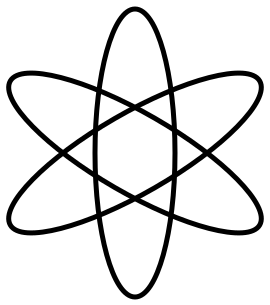
Atoms are made up of three types of particles: protons, neutrons and electrons. The protons and neutrons are clumped together in the centre of the atom, in a region called the nucleus. The electrons orbit this nucleus, much like the planets orbit the Sun. Electrons are negatively charged, protons are positively charged, and neutrons are neutral (no charge). Opposite charges attract (see Electricity), so the protons in the nucleus attract the electrons, which is what stops them flying off into space.
An atom overall must be neutral, which means that all the charges that exist within it must cancel out. It turns out that the amount of charge that an electron has is equal, but opposite, to the amount of charge that a proton has. Therefore, an atom must have an equal amount of protons and electrons for this cancellation to happen.
Types of Atom
The different types of atoms are called elements. There are lots of common, everyday elements like Oxygen, Iron and Carbon, alongside rarer ones like Uranium. The element, i.e. the type of atom, is defined by the number of protons it has in its nucleus. For example, if an atom has 8 protons it is called Oxygen, if it has 26 it is called Iron, and if it has 6 it is called Carbon.
In reality it is not that common to get objects that are made up solely of a single element, they are more commonly made of compounds. These compounds are simply groups of atoms joined together, and include common materials like carbon dioxide (CO~2~) or water (H~2~O).